Adopting AI for email marketing changes how businesses communicate with subscribers, turning rigid broadcast schedules into responsive customer journeys powered by AI in email marketing. Rather than blasting uniform newsletters to an entire database, modern marketing teams use artificial intelligence to understand customer intent, tailor messaging to individual buying stages, and automate follow-up without losing human oversight. Explore our broader AI marketing strategy guide to see how email integrates into full-funnel growth systems.
1. What is AI email marketing?
AI email marketing is the deployment of machine learning algorithms, natural language processing, and automated workflow logic to optimize subscriber segmentation, draft personalized content, determine optimal send times, and trigger contextual follow-ups across the customer lifecycle. Instead of treating every recipient identically, an intelligent email system analyzes subscriber interaction history, purchase recency, and browsing signals to deliver timely, relevant messages.
When asking what is AI email marketing and what is AI powered email marketing, the clearest contrast is with traditional broadcast campaigns. Conventional software relies on scheduled batch sends where an entire list receives identical copy regardless of individual interest. By contrast, intelligent campaigns organize messaging around continuous customer signals. Machine learning models detect patterns in when individuals engage, what topics they explore, and when their interest wanes, allowing teams to intervene before subscribers disengage entirely.
At its core, email marketing AI solves two operational challenges: speed and relevance. Generative models assist teams in drafting subject lines, preview text, and modular body copy, while predictive classification groups contacts into meaningful behavioral cohorts. Deploying AI based email marketing does not mean replacing marketing strategy with unguided automation. Running email marketing with AI allows marketing teams to focus on campaign strategy, offer design, and customer insights while automated workflows handle continuous segmentation and delivery.
When starting, connect email touchpoints directly to your acquisition funnel. For an end-to-end framework on capturing high-intent inquiries before nurturing them via email, read our comprehensive guide on AI lead generation.
2. How to use AI for email marketing across campaign workflows
To understand how to use AI for email marketing across campaign workflows, businesses structure their subscriber lifecycle across six connected stages: data collection, dynamic segmentation, generative drafting, human editorial approval, automated delivery, and revenue-based measurement. Each stage builds on the previous one, ensuring artificial intelligence enhances message relevance without introducing brand risk.
Teams exploring how to use AI in email marketing often make the mistake of jumping directly to automated content generation without organizing their data foundation. Effective execution requires a disciplined sequence. When using AI for email marketing, data quality dictates output quality; unorganized customer records lead to generic recommendations and disjointed messaging. Aligning AI and email marketing around a structured lifecycle turns subscriber data into predictable customer relationships.
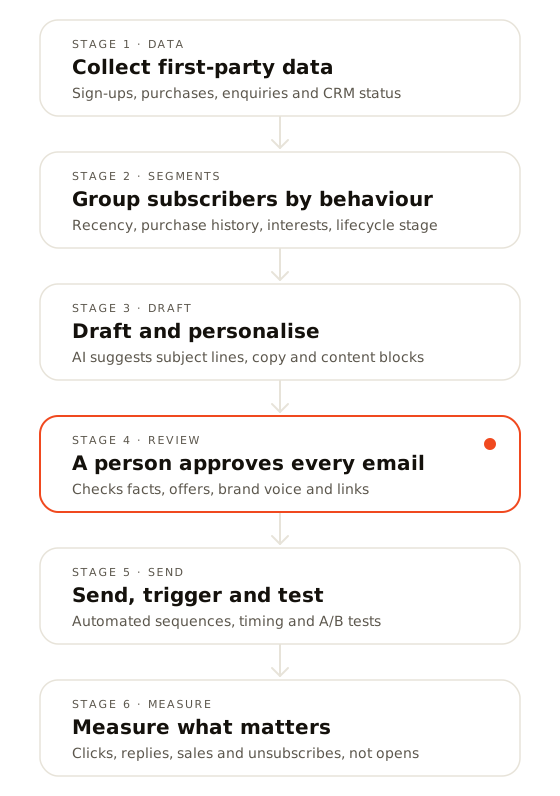
The workflow diagram illustrates how information progresses through an operational system:
- First-Party Data Collection: Ingesting verified customer actions from form submissions, website activity, e-commerce purchases, and CRM milestone updates.
- Dynamic Segmentation: Grouping subscribers into responsive clusters based on demonstrated interest, purchase velocity, and engagement recency.
- Generative Drafting and Personalization: Creating tailored subject line options, preview snippets, and modular body copy matched to specific audience segments.
- Human Editorial Approval: A person reviews and verifies every campaign before it deploys, checking factual claims, tone, links, and commercial alignment.
- Automated Delivery and Testing: Triggering timely messages, optimizing delivery windows, and running systematic A/B split tests on messaging variants.
- Downstream Measurement: Evaluating campaign success on concrete business metrics—click-through rates, direct replies, demo requests, and attributed sales—rather than unverified open rates.
In practice, moving smoothly between stages requires clean data. When an enquiry arrives through your website or a customer creates an account, your site records the enquiry and its referral source. Your CRM logs the contact's stage and updates your email platform immediately, so new subscribers receive the right messages without delay.
3. AI email marketing automation and triggered customer workflows
AI email marketing automation replaces static, scheduled batch blasts with triggered customer workflows that respond dynamically to live subscriber behavior, purchase intent, and CRM lifecycle milestones. Instead of forcing every contact through a rigid schedule, triggered workflows deliver relevant guidance at the exact moment a prospect takes action.
To evaluate what is email marketing automation in a modern context, consider how triggered communication has evolved. Traditional drip automation relied on simple, time-delayed sequences—such as sending a follow-up message three days after an initial download regardless of whether the lead had already purchased. Modern email automation connects directly to website events, CRM deal stages, and product signals. When paired with AI email automation, the workflow determines the next communication based on what the prospect actually did, not an arbitrary delay.
Deploying automated email campaigns around customer intent delivers measurable results across four foundational workflows:
- Inquiry and Welcome Sequences: Welcoming new subscribers immediately with helpful resources, setting communication expectations, and introducing your core point of view. For inbound inquiries, fast follow-up directly improves conversion rates; integrate your sequences with our speed-to-lead automation guide to route qualified leads instantly before starting structured email nurture.
- Post-Inquiry Nurture Cadences: Educating qualified prospects who requested information but require multi-stakeholder approval or technical evaluation before purchasing. Connect these cadences with structured lead generation services to guide prospects from initial awareness to qualified sales opportunities.
- E-commerce Lifecycle Workflows: Using AI email marketing for ecommerce lets online stores re-engage shoppers who viewed specific products, abandoned items in a digital cart, or reached a regular reorder window. Automated sequences dynamically populate product images, usage recommendations, and inventory availability based on first-party store data.
- Re-Engagement and Sunset Automation: Identifying subscribers whose activity has decayed over several months. Automated re-engagement workflows present a direct preference-update option, and automatically sunset inactive addresses to maintain sending domain reputation and keep spam complaint rates low.
For organizations looking to implement customized, multi-channel customer workflows that bridge email, messaging, and CRM records, explore our specialized AI automation agency services.
4. AI email personalization and dynamic segmentation
AI email personalization moves subscriber targeting beyond basic merge tags by using machine learning models to cluster contacts based on browsing history, engagement frequency, and lifecycle progression. While traditional personalization was limited to inserting a recipient's first name or company into a static template, intelligent personalization shapes the narrative, modular content blocks, and recommendations delivered to each cohort.
Effective AI email marketing personalization starts with organizing customer records into distinct behavioural segments. Instead of relying on static industry tags, machine learning email marketing algorithms evaluate multidimensional subscriber attributes in real time. One practical framework is RFM modeling, which analyzes three customer dimensions:
- Recency: How recently did the subscriber visit the website, open an email, or complete a purchase? Recent activity signals active evaluation.
- Frequency: How often does the contact engage with your educational content or place orders? Frequent purchases or repeat visits show strong customer loyalty.
- Monetary Value: What is the historical customer spend or pipeline deal size associated with the account? High monetary value justifies tailored commercial messaging.
By scoring subscribers across these three dimensions in plain business terms, automated systems dynamically populate modular email sections. A prospective buyer reviewing technical documentation receives case studies and implementation guides, while an existing customer receives practical optimization workflows and product updates. Modular assembly ensures your team maintains a single master template while delivering distinct, relevant value to every recipient.
A common operational pitfall is over-segmentation: creating dozens of hyper-specific micro-segments with too few recipients to generate statistically meaningful engagement. Start with three to five foundational segments—such as new evaluators, active customers, and inactive contacts. Once baseline engagement metrics stabilize across these core groups, introduce dynamic modular blocks to tailor product recommendations and case studies without fragmenting your subscriber list into unmanageable silos. Regular list maintenance should accompany dynamic segmentation. Removing invalid addresses and monitoring unengaged subscribers protects sender reputation across mailbox providers and ensures campaign analytics accurately reflect genuine customer interest.
5. AI email copywriting, subject lines, and human-in-the-loop review
AI email copywriting accelerates the production of subject lines, preview text, and modular body passages, but requires strict human-in-the-loop editorial review before any message is scheduled or deployed. Generative language tools provide an efficient creative collaborator for exploring variations and overcoming the blank page, but they must operate under disciplined human guidance.
When teams develop ChatGPT email marketing workflows, they create structured AI prompts for email marketing with explicit brand guidelines:
- Audience Persona and Context: Specifying the subscriber's role, their specific operational challenges, and what action they took to trigger the email.
- Objective and Value Hook: Defining the core educational takeaway or resource offer before drafting begins.
- Voice and Tone Boundaries: Providing clear guidelines on style—clear, direct, and helpful—with explicit instructions to avoid hyperbolic adjectives, promotional clichés, and fabricated guarantees.
- Structural Constraints: Setting clear limits on paragraph length, bullet structures, and call-to-action clarity.
Founders and marketing directors often ask: can AI do email marketing on its own without human oversight? The short answer is that autonomous, unreviewed email delivery is high-risk. Language models can hallucinate product specifications, misquote pricing terms, or produce generic prose that damages customer trust. A practical standard is a collaborative review model: artificial intelligence drafts subject line angles and modular copy blocks, while an editor reviews every line, verifies factual claims, checks links, and refines the tone before scheduling the campaign.
6. How to choose AI email marketing tools, deliverability, and spam filters
When evaluating how to choose AI email marketing tools, deliverability standards and technical infrastructure matter far more than generative features alone. An intelligent drafting assistant is useless if your messages land in junk folders or fail sender authentication checks. Technical governance and mailbox reputation must form the foundation of any software evaluation.
Selecting campaign software requires looking past surface-level interface features. When evaluating AI tools for email marketing, check four practical capabilities:
- Data Privacy and Training Governance: Check the software provider's data-retention and model training terms. Ensure you use business plans that do not use your customer records, subscriber communications, or proprietary data to train public AI models by default where available.
- Native CRM and Data Synchronization: The platform must support two-way synchronization with your customer relationship management database, updating contact engagement stages and syncing unsubscribe requests in real time.
- Strict Editorial Approval Workflows: The software interface should enforce role-based permissions, requiring a human editor to review and approve generated campaigns before messages deploy.
- Reliable Deliverability Controls: The platform must provide native support for custom sending domains and automated compliance monitoring.
To understand how mailbox providers evaluate incoming messages, look at the AI used for email spam filters. Mailbox providers like Google and Yahoo deploy automated machine learning systems that evaluate sender reputation, message structure, and recipient engagement. Senders must adhere to strict technical guidelines:
- Google Bulk-Sender Requirements: Under official Google bulk-sender guidelines, organizations sending more than 5,000 messages a day to Gmail accounts must authenticate their domain using SPF, DKIM, and DMARC. All senders require SPF or DKIM. Bulk senders must also provide a clear, one-click unsubscribe header for marketing and subscribed messages, and keep spam complaint rates reported in Google Postmaster Tools below 0.10%, never reaching 0.30%.
- Yahoo Bulk-Sender Requirements: Under documented Yahoo sender requirements, all senders must authenticate with SPF or DKIM and keep spam complaint rates below 0.3%. Bulk senders must authenticate with both SPF and DKIM, publish a DMARC policy (at least p=none), implement a functional one-click unsubscribe header for marketing messages, and honor unsubscribe requests within 2 days.
- Apple Mail Privacy Protection (MPP): In Apple Mail Privacy Protection guidelines, Apple explains that when users turn on Mail Privacy Protection, it hides their IP address and prevents senders from seeing whether the email was opened. Because senders cannot tell whether an email was opened, open rates are an unreliable metric. Teams evaluate campaign performance based on click-through rates, direct replies, form submissions, and verified downstream purchases.
Automated deliverability tools can assist by monitoring domain reputation, alerting teams to sudden engagement decay, and detecting spam-trigger language in drafts. However, technical authentication, DNS record management, and subscriber list hygiene are ultimately configured and maintained by people. For advice on configuring closed-loop attribution tracking and measuring real business outcomes across marketing channels, explore our dedicated tracking and analytics services.
Want it built and run for you?
Our email marketing services set up the automated flows, campaigns and deliverability described here, with a person reviewing every AI-written email before it is sent.
7. Frequently Asked Questions (FAQ)
What is AI email marketing?
AI email marketing is the deployment of machine learning algorithms, natural language processing, and automated workflow logic to optimize subscriber segmentation, draft personalized content, determine optimal send times, and trigger contextual follow-ups across the customer lifecycle.
What is email marketing automation?
Email marketing automation is the use of software to send targeted emails based on defined triggers, schedules, or subscriber actions. Combining automation with AI allows workflows to adapt message timing, content, and segmentation dynamically based on real-time engagement and customer data rather than relying solely on rigid if-then rules.
Can AI do email marketing on its own?
While AI tools can generate subject lines, draft copy, and predict optimal delivery times, running campaigns entirely autonomously without human approval introduces significant risks of factual errors, off-brand messaging, and compliance issues. The safest approach is a human-in-the-loop workflow where a person reviews and approves every email before it is sent.
Will AI replace email marketing?
No, AI will not replace email marketing; it changes how email campaigns are planned and produced. Email remains a direct, owned communication channel with customers that does not depend on third-party ad algorithms. AI improves the speed of drafting, audience segmentation, and workflow automation while human strategy guides the messaging.
Is AI used for email spam filters?
Yes, major mailbox providers use automated systems and machine learning to analyze incoming email patterns, sender reputation, and user engagement to detect spam. Senders protect their deliverability by authenticating their sending domain with SPF, DKIM, and DMARC, maintaining clean subscriber lists, providing clear one-click unsubscribe links, and keeping spam complaint rates low.
Can you use ChatGPT for email marketing?
Yes, ChatGPT can be used to brainstorm campaign angles, draft subject lines, and outline body copy. When using generative tools for email copywriting, provide clear brand guidelines, verify that all product details and links are accurate, check provider data-retention settings to ensure business data is not used for model training, and always have a person review the copy before scheduling.
How does AI email personalization work?
AI email personalization analyzes subscriber data—such as past purchases, website browsing activity, content downloads, and CRM status—to assemble dynamic content blocks, product recommendations, and tailored messaging for each recipient instead of relying solely on basic merge tags like first names.
How do you choose AI tools for email marketing?
When choosing AI tools for email marketing, prioritize platforms that integrate directly with your CRM and customer database, provide transparent data-retention and training settings, and offer robust deliverability controls. The tool should support custom workflow triggers and allow human approval before emails deploy.