1. What is AI lead generation?
AI lead generation is the deployment of machine learning algorithms, natural language processing models, and autonomous workflow logic to identify high-probability prospective buyers, capture inbound intent, qualify deal parameters, and route sales-ready opportunities into CRM pipelines without manual delay. Rather than replacing commercial strategy, practical artificial intelligence reorganizes acquisition around structured data.
Traditional acquisition systems rely on static web forms that collect unverified contact information and drop entries into flat email inboxes or unmanaged spreadsheets. Sales representatives often spend hours evaluating whether an inquiry meets minimum budget thresholds or matches the company's service scope. In contrast, lead generation ai introduces cognitive processing at every acquisition node. By parsing unstructured natural language, querying live databases, and validating intent signals in real time, ai powered lead generation converts fragmented web traffic into predictable pipeline value.
Modern lead generation with ai operates as an integrated four-part loop:
- Inbound Discovery & Capture: Synthesizing high-intent organic and paid search queries through targeted lead generation campaigns and content engineered for AI search engines, directing prospects to conversational or structured intake surfaces.
- Contextual Enrichment: Automatically retrieving firmographic details, technology installations, company headcount, and verified business domains the moment an inquiry arrives.
- Intelligent Qualification: Deploying language models to analyze project requirements, compare parameters against ideal customer profile (ICP) guidelines, and assign a fit score based on your criteria.
- Deterministic Distribution: Routing qualified opportunities to account executives within seconds to minutes, booking meetings directly into sales calendars, or initiating personalized nurture workflows.
In our architectural work at spark5x, we view ai based lead generation not as a collection of disjointed point solutions, but as an essential subsystem of modern AI marketing strategy. When artificial intelligence is grounded in first-party data and bound to strict operational rules, sales teams spend their working hours in high-leverage conversations rather than manual data reconciliation. Understanding how ai in lead generation transforms the funnel is the first step toward building an resilient growth engine.
2. How to use AI for lead generation across the funnel
Deploying ai for lead generation effectively requires matching specific model capabilities to distinct funnel milestones. Attempting to use a single conversational model for every task invites hallucinations and process failure. Instead, high-performing revenue operations map dedicated algorithms across top-of-funnel discovery, middle-of-funnel intake, and bottom-of-funnel routing.
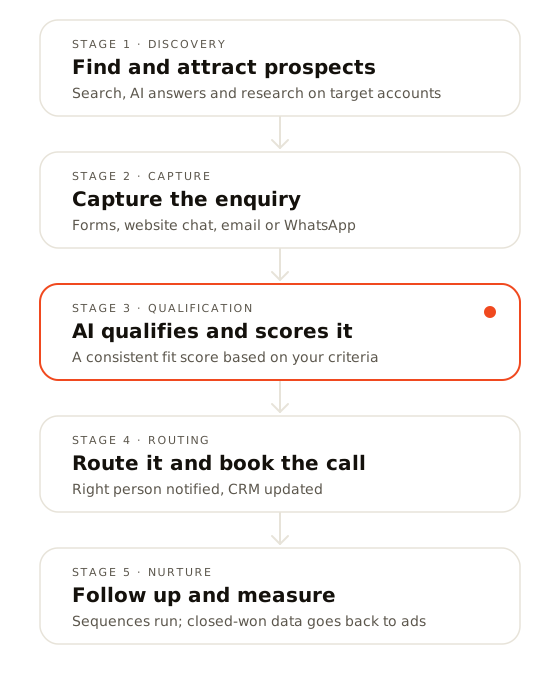
Here is an operational breakdown of how to use ai for lead generation across each stage of the acquisition pipeline:
Top-of-Funnel: Intent Identification and Dynamic Ingestion
At the top of the funnel, machine learning models analyze behavioral signals across web properties and ad channels to evaluate buyer readiness. By examining content engagement depth, referral source context, and repeat visit frequency, models calculate initial propensity scores before a visitor ever submits a form. Inbound visitors who display research-stage behavior receive contextual education, while high-intent visitors are offered direct conversational qualification paths.
Middle-of-Funnel: Conversational Qualification and Data Extraction
Once a prospect interacts with an intake surface, using ai for lead generation shifts toward interactive qualification. Rather than subjecting prospects to exhaustive 12-field static web forms—which suppress conversion rates—teams deploy grounded AI chatbot assistants that hold natural conversations. The model gathers project scope, timeline, operational scale, and current technical architecture, extracting these variables into structured JSON objects behind the scenes.
Bottom-of-Funnel: Instant Dispatch and Automated Routing
The bottom of the funnel is where lead value is either secured or lost to response latency. Traditional sales cycles allow hours or days to elapse between form submission and initial contact. Modern AI workflows shrink this gap by connecting qualification evaluators directly to calendar booking engines, telephony APIs, and sales team notification channels. For an in-depth blueprint on engineering instant response pipelines, review our dedicated speed-to-lead automation guide and our full-stack AI automation services.
Post-Capture: Intelligent Nurturing Loops
Not every valid inquiry is ready for an immediate sales call. Systematic ai lead nurturing monitors prospect engagement with proposals, documentation, and product resources. When an account resumes activity—such as re-visiting pricing pages or reviewing technical specifications—the system dynamically re-alerts the assigned account owner with actionable context. For structured lifecycle sequences across email, read our dedicated AI email marketing playbook.
3. AI for sales prospecting and B2B lead generation
Sales development teams in B2B environments frequently lose dozens of hours every week manually researching target accounts, compiling contact directories, and drafting introductory emails. Deploying ai for sales prospecting automates the data aggregation phase, equipping human sales professionals with rich background dossiers before they begin outreach.
Operational Boundary & Deliverability Warning: While machine learning accelerates account research, deploying unmonitored autonomous scrapers to blast thousands of unverified cold emails is counterproductive. Mass automated emailing burns company domain reputation, triggers spam filter blacklists, and damages brand trust. In our operational methodology, ai b2b lead generation is applied to research synthesis and contextual qualification, leaving final messaging approval in human hands.
Modern ai prospecting platforms examine public databases, corporate filings, job board hiring signals, and technographic scanners to detect commercial intent. When evaluating prospective enterprise accounts, ai sales prospecting models identify high-relevance triggers:
- Hiring Spikes: New job openings in specific technical roles indicate upcoming infrastructure projects and budget expansion.
- Tech-Stack Transitions: Changes in underlying analytics, CRM, or advertising scripts signal platform migrations and new vendor evaluations.
- Executive Leadership Changes: New department leaders often review their software and vendors early in the role.
| Prospecting Approach | Data Accuracy & Depth | Deliverability & Reputation Risk | Typical Cost Profile |
|---|---|---|---|
| Manual B2B Research | High contextual accuracy, but slow output (5-10 accounts per day). | Minimal risk; highly tailored messaging protects sending domain. | High labor overhead per qualified account. |
| AI-Assisted Account Intelligence | High accuracy; synthesizes technographics and intent signals across hundreds of accounts in minutes. | Low risk; human oversight verifies messaging and compliance before sending. | Predictable software tooling with high sales representative leverage. |
| Unvetted Mass Scraping | Poor accuracy; high bounce rates from stale email addresses and generic contacts. | Severe risk; domain blacklisting and spam filter flags. | Low initial software cost, catastrophic brand and infrastructure loss. |
Used this way, AI for B2B lead generation helps growth teams build deeper prospect research while protecting their sending domain. Our performance marketing and inbound lead generation systems are built to pair verified demand capture with compliant outbound research workflows.
4. AI lead generation tools: the main types and how to choose
AI lead generation tools fall into five groups: prospect research and data enrichment, conversational capture, AI lead scoring, workflow automation, and general AI assistants. The right mix depends on where leads are lost in your funnel, not on which tool has the most features.
| Tool type | What it does | Best for |
|---|---|---|
| Research and enrichment | Finds companies and contacts that match your ideal customer profile and fills in missing firmographic details. | B2B teams researching accounts before outreach. |
| Conversational capture | Chat and messaging assistants that answer questions, collect details and qualify visitors at any hour. | Websites and ad landing pages with steady inbound traffic. |
| AI lead scoring | Ranks leads by how likely they are to buy, using CRM history and engagement, often built into CRMs such as Salesforce Einstein Lead Scoring. | Teams with more leads than sales time. |
| Workflow automation | Connects forms, AI models and your CRM so leads are scored, routed and followed up automatically. | Removing manual handoffs and slow first replies. |
| General AI assistants | Assistants such as ChatGPT, Claude and Gemini that draft outreach, summarise accounts and research prospects. | Speeding up research and writing tasks for sales teams. |
When comparing AI lead generation software, check five things before price or feature lists:
- CRM integration: it should read from and write to your CRM, so scores and conversations live where your sales team works.
- Data quality: enrichment and scoring are only as good as the data behind them, so test accuracy on your own leads first.
- Compliance: it should respect consent and privacy rules in the regions you sell to and avoid mass unsolicited outreach.
- Human oversight: your team should be able to review, correct and override AI decisions.
- Measurable results: it should report on qualified leads and revenue, not just activity volume.
Many businesses get the most value by connecting the tools they already have rather than adding new ones; our workflow automation team builds those connections.
5. AI lead scoring, qualification and routing systems
The central engine of any automated pipeline is ai lead qualification. When an inquiry enters the system, an LLM evaluator inspects the submitted unstructured data, applies deterministic grading criteria, and generates a structured payload for downstream processing.
From Unstructured Text to Structured Qualification Schemas
When prospective clients fill out free-text fields or converse with a website assistant, their responses vary wildly in tone, detail, and structure. An LLM evaluator processes this raw text against strict JSON schema definitions. Consider this sample extraction payload generated by an automated triage agent:
{
  "prospect_intent": "CRM integration and custom lead scoring",
  "estimated_budget_tier": "Enterprise ($10k+/month)",
  "timeline_urgency": "Immediate (under 30 days)",
  "technical_dependencies": ["HubSpot Enterprise", "Cloudflare Workers", "Stripe"],
  "qualification_score": 88,
  "fit_status": "HIGH_FIT",
  "routing_action": "DISPATCH_DIRECT_CALENDAR"
}
Rule-Based Scoring vs LLM Semantic Evaluation
Traditional marketing automation tools rely strictly on rigid if/then logic: if a user selects "Company Size: 50+", add 10 points. If they do not select that exact option, they receive 0 points. This approach breaks down when prospects provide nuanced context such as "We are a boutique firm of 8 consultants managing 400 client accounts with high monthly volume."
Semantic evaluation models understand operational context. Rather than relying solely on arbitrary checkboxes, the model assesses business scale, technical complexity, and urgency, assigning a consistent fit score based on your criteria. This makes it far less likely that a high-value opportunity is dismissed because of rigid form fields.
Intelligent Pipeline Routing Logic
Once scored, ai lead management systems distribute opportunities based on pre-defined business rules:
- Tier 1 (High Fit / High Budget): Dispatches an immediate booking link via SMS and email, pings the dedicated sales director in an internal messaging channel, and reserves the prospect's calendar slot.
- Tier 2 (Moderate Fit / Standard Project): Creates a newly staged deal in the CRM, enrolls the prospect in an automated verification workflow, and assigns the contact to an available account representative.
- Tier 3 (Low Fit / Out of Scope): Sends an automated, courteous response directing the user to public documentation, educational articles, or partner networks, protecting sales calendar capacity.
These routing pathways integrate seamlessly with enterprise CRM automation architectures. Furthermore, when high-tier deals close, those conversion milestones are fed directly back into ad networks via offline conversion tracking for Google Ads, training advertising bidding algorithms to locate similar enterprise buyers.
6. AI lead generation examples, benefits, and practical challenges
The two scenarios below are illustrations of how these workflows can be set up, not client results.

Illustrative Deployment Examples
Example 1: High-Ticket Professional Services Firm
Imagine a commercial consulting firm that receives complex web inquiries and adds an AI qualification webhook. Inquiries submitted through its site are ingested by an LLM that references their service catalog, extracts firmographic data, and compiles an executive briefing dossier. When the partner joins the discovery call, they already have a full summary of the prospect's current software stack, suspected bottlenecks, and target timeline, elevating the depth of the initial conversation.
Example 2: 24/7 Service Contractor
Now picture a commercial HVAC and emergency facilities contractor that loses inquiries submitted outside business hours. With a conversational intake assistant, emergency service requests can be evaluated within seconds, technician dispatch alerts are triggered based on geographical zone, and standard quotes are queued for morning review. The aim is a shorter response delay, so fewer prospects move on to a competing provider.
Core Operational Benefits
- Reducing Speed-to-Lead Decay: A reply within minutes, not the next day, gives prospects less time to contact a competitor.
- Standardized Qualification Adherence: Every inbound inquiry is evaluated against the same ICP rules, which reduces the inconsistency that creeps in when people triage leads while tired or rushed.
- Less Manual Data Entry: Reps no longer copy and paste notes between forms, inboxes, and CRM records; all extracted variables populate standard database properties automatically.
Practical Challenges and Engineering Safeguards
While the benefits are substantial, engineering automated pipelines requires rigorous technical governance:
- Model Hallucinations: If an intake agent is prompted loosely, it may invent services or quote inaccurate pricing. Safeguard: Bind the model strictly to approved JSON schemas with temperature settings at 0.0, and prohibit generative pricing commitments.
- Input Tampering & Prompt Injection: Unfiltered web inputs can contain adversarial text attempting to bypass qualification rules. Safeguard: Separate user input ingestion from internal system instructions using isolated prompt delimiters and strict validation layers.
- API Latency vs Webhook Timeouts: Complex multi-step LLM calls can exceed standard 10-second webhook timeouts. Safeguard: Decouple intake acknowledgment from downstream LLM evaluation using asynchronous message queues.
- Data Privacy and PII Protection: Sending confidential prospect records to public model APIs risks compliance violations. Safeguard: Use AI providers' business or API plans with data-retention and training opt-out settings where available, and encrypt data in transit.
7. How to build an AI lead generation workflow for your business
Building an enterprise-grade qualification pipeline does not require complex machine learning engineering from scratch. Organizations can build reliable architectures using accessible tools when following a disciplined engineering roadmap.
Step 1: Codify Your Ideal Customer Profile and Disqualifiers
Before writing a line of code or prompt text, define your exact qualification parameters. When teams evaluate ai lead generation free templates or frameworks, they often discover that success depends on crisp definition rather than tool complexity. What is your minimum project budget? What software platforms do you support? What timeline indicates immediate purchase intent? Explicitly document both qualifying attributes and deal-breaking disqualifiers.
Step 2: Establish Ingestion Surfaces and Webhook Triggers
Rather than relying on isolated lead generation ai tools that trap prospect data in separate dashboards, connect your primary intake surfaces—including web forms, interactive landing pages, and conversational chat widgets—to a centralized webhook receiver. Tools like Make, n8n, or custom serverless Cloudflare Workers emit standard HTTP POST requests containing raw prospect data immediately upon submission.
Step 3: Implement Grounded LLM Evaluation with JSON Output
Direct incoming payloads to a dedicated API endpoint using models like Claude 3.5 Sonnet or GPT-4o. While ungrounded consumer prompts or basic chatgpt for lead generation experiments offer quick initial drafts, production qualification requires deterministic system prompts bound to your ICP rules. Require the model to return only valid JSON matching your schema, and set model temperature to 0.0 to ensure consistent, reproducible scoring.
Step 4: Configure CRM Synchronization and Sales Alerts
Configuring automated routing bridges the gap between raw intelligence and execution, transforming standalone ai lead generation tools into a coordinated revenue engine. Parse the JSON response and route properties into your CRM (HubSpot, Salesforce, Zoho, or Airtable). Create or update contact records, attach the extracted qualification summary to the lead timeline, and dispatch instantaneous alerts to your commercial team via Slack, Microsoft Teams, or SMS.
Step 5: Activate Attribution Loops and Ad Network Feedback
When leads achieve qualified status or convert into paying clients, pass these lifecycle milestones back to Google Ads and Meta Ads using offline conversion tracking APIs. This trains advertising bidding algorithms to prioritize users matching your highest-converting buyer profiles.
Step 6: Maintain Continuous Audit Logs and Human Oversight
Review qualification transcripts weekly. Monitor false positives (unqualified leads routed to sales) and false negatives (strong prospects mistakenly deflected) to refine prompt instructions and adjust scoring thresholds over time.
For enterprises evaluating whether to build internal pipelines or engage specialized ai lead generation companies, partnering with an established ai lead generation agency accelerates delivery while avoiding architectural missteps. Commercial pipeline stability requires custom webhook integration, robust error handling, and end-to-end attribution governance. Discover how spark5x designs and deploys custom revenue infrastructure through our integrated lead generation and AI automation services.
8. Frequently Asked Questions (FAQ)
What is the best AI for lead generation?
The best AI for lead generation depends on your pipeline bottleneck. For conversational website intake and triage, fine-tuned LLM agents integrated with vector retrieval excel. For B2B account intelligence, specialized firmographic enrichment platforms perform best. For pipeline routing, custom webhook automation connecting LLM evaluators to your CRM provides the most reliable architecture.
What is AI lead scoring?
AI lead scoring uses machine learning or language models to rank leads by how likely they are to become customers, based on signals such as company fit, behaviour and what the lead wrote in their enquiry. Unlike fixed points-based rules, it learns from your past wins and losses, so sales teams can focus first on the leads most likely to close.
What are AI lead generation tools?
AI lead generation tools are software that use AI to find, capture, qualify or follow up with potential customers. They include prospect research and enrichment platforms, website chat assistants, AI lead scoring built into CRMs, workflow automation that routes leads, and general assistants such as ChatGPT for research and drafting.
How do you use AI for lead generation without getting flagged for spam?
Avoid mass automated cold outreach scrapers. Deploy AI for inbound qualification, research enrichment, and contextual follow-up, while maintaining strict DNS authentication (SPF, DKIM, DMARC), email list hygiene, and human review before sending outbound messages.
What is the difference between AI lead generation and traditional marketing automation?
Traditional automation relies on rigid, pre-scripted if/then rules triggered by button clicks. AI lead generation parses unstructured natural language, extracts qualification intent from free-text replies, retrieves verified answers from company documents, and dynamically routes leads based on context.
How does AI lead qualification determine if a prospect is a good fit?
The qualification engine evaluates submitted project requirements against predefined ideal customer profile (ICP) criteria—such as budget readiness, service scope, operational scale, and timeline—assigning a consistent fit score based on your criteria before notifying sales reps.
Does AI lead generation for small business and local service firms work?
Yes. Lean teams benefit significantly because AI handles instant 24/7 inquiry triage, appointment scheduling, and basic FAQ resolution, allowing small teams to maintain enterprise-level responsiveness without hiring full-time intake coordinators.
How do you use ChatGPT for lead generation?
ChatGPT is most effectively used as an operational research and drafting assistant: analyzing prospect pain points, summarizing account signals, and drafting personalized outreach or qualification questions. For live customer interactions, private API endpoints with training opt-outs and document grounding should be used rather than unvetted public prompts.
What are the biggest risks of using AI in lead generation?
The main risks are model hallucinations (stating inaccurate pricing or capabilities), data privacy breaches from inputting customer PII into unvetted consumer tools, and brand reputation damage from firing unreviewed, generic automated messages.
Is AI lead generation worth it for B2B companies?
It is worth the investment when high-value sales opportunities are currently lost to slow response times or fragmented CRM handoffs. If enquiry volume is low or the core service offering is unproven, focusing on foundational acquisition channels will yield better returns.